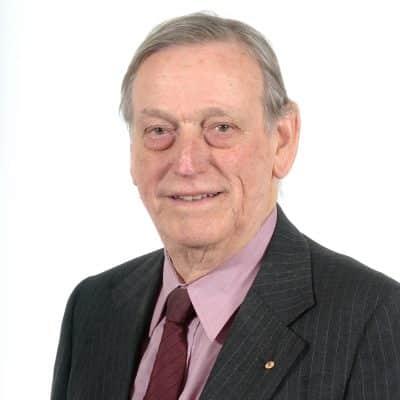
It is with great sadness that we advise our members of the passing of Professor Colin Ivor Johnston AO, a Founding Member of the Foundation for High Blood Pressure Research, a long-term member of the High Blood Pressure Research Council of Australia and its President between 1990-1992. Colin was an outstanding cardiovascular physician, researcher, colleague, mentor and friend and his legacy continues to be remembered through one of the most prestigious lectureships that is awarded in his name since 2005.
A promising young cardiovascular research fellow and athlete at the national competitive level, Colin was appointed first assistant in the Department of Medicine at the Austin Hospital in Melbourne in 1968 by the late Austin Doyle. Colin proved himself to be an outstanding clinical scientist, respected internationally for his leadership and achievements. His credentials include authorship of over 450 papers in leading international journals, supervision of 70 doctoral students and postdoctoral fellows, membership to the editorial boards of 13 international journals and invitations to present at many scientific conferences. His most significant research contributions have been in the clinical and experimental fields addressing the renal and hormonal regulation of blood pressure. He was vice president of the International Society of Hypertension from 1988 to 1990 and chairman of the organising committee for the highly successful 15th Scientific Meeting of the International Society of Hypertension in Melbourne in 1994. Colin has been a tireless contributor to hospital, university, and professional boards and committees. His opinion was always highly regarded by everyone from undergraduate students to multinational pharmaceutical companies.
His conspicuous accomplishments have been honoured in many ways. Scientific peers awarded Colin the Franz Volhard Award of the International Society of Hypertension in 1992 and the Richard Bright Distinguished Award of the American Society of Hypertension in 1995. His clinical peers awarded him the College Medal of the Royal Australasian College of Physicians in 1995, and in 1996, his country bestowed the award of Officer of the Order of Australia (AO).
While retiring as Professor and Head of the Department of Medicine at the Austin Hospital in December 1999, he continued to serve the scientific and medical community in many roles including mentoring the next generation of clinicians and researchers.
His contributions will continue to impact on many generations to come.