
Dear Colleagues and Friends
And with that, we are at the end of another buzzing year. So many things happened in the world of high blood pressure, and we hopefully were able to capture a bit of these events in each of our Newsletters. I hope you will enjoy the content of this newsletter, with many research reports from our own Australian researchers!
I would like to take this opportunity to thank the amazing team that worked with me in putting each of these newsletters together in the past year. In particular, Clare Collins, Ellie Clapham, Bhavisha Bakrania, and finally Jessica Guild, who added all the beautiful technical touches. It was a real pleasure to work with everyone, and sadly, this will be my last newsletter as Chair of the Communications Committee. Yet, I will remain very much engaged with all future things ‘hypertension’!
I hope to see each of you in Adelaide joining us at the Annual Scientific Meeting. There is nothing like an in-person event with excellent science, engagement and friends.
Please feel free to share our newsletter with colleagues far and wide.
Very best wishes,
Alta Schutte
Chair, Communications Committee
Hypertension Australia
If you would like to have this newsletter delivered to your inbox, please subscribe here.
A 2024-2025 survey of 2,000 Australians using antihypertensive medications found 89% preferred pharmacy pickup over postal delivery. However, when cost savings were presented, preferences shifted toward longer dispensing intervals. Participants cited benefits including social interaction and medical advice from pharmacy visits, though some valued postal delivery’s convenience and time-saving advantages.
Phase 3 trial of 796 patients with uncontrolled or resistant hypertension found baxdrostat, an aldosterone synthase inhibitor, significantly reduced seated systolic blood pressure versus placebo at 12 weeks. Both 1mg and 2mg doses achieved placebo-corrected reductions of 8.7 and 9.8 mm Hg respectively. Elevated potassium occurred in 2-3% of patients.
Clinical trial found participants with lower wholegrain and dietary fibre intake at baseline responded better to prebiotic fibre intervention, achieving 10 mm Hg systolic blood pressure reduction versus nonresponders. Responders consumed more refined grains and were enriched in SCFA-producing gut bacteria including Bifidobacterium and Roseburia. Findings support personalised nutrition approaches for hypertension treatment.
This editorial highlights the preclinical research linking male sex hormones to hypertension via gut microbiota. Androgens reshape the gut microbiome to produce trimethylamine, elevating TMAO levels which trigger neuroinflammation and increased sympathetic activity. Pharmacological blockade of microbial trimethylamine synthesis lowered blood pressure, suggesting the microbiota-TMAO pathway plays a causal role in sex-specific hypertension.
The Global Burden of Disease 2023 study found CVDs remain the leading cause of death and disability worldwide, with 437 million DALYs in 2023—a 1.4-fold increase since 1990. Nearly 80% of burden is attributable to modifiable risk factors, particularly high blood pressure, dietary risks, and high LDL cholesterol. Population growth and aging drove increased burden.
The new 2025 Canadian guideline recommends single-pill combination therapy as preferred initial treatment for most adults with hypertension. The treatment algorithm prioritises early combination therapy over monotherapy, uses the HEARTS framework for streamlined care delivery, and defines high cardiovascular risk conditions including diabetes, chronic kidney disease, and age ≥75 years requiring earlier intervention.
The 2025 US hypertension guideline replaces pooled cohort equations with PREVENT for cardiovascular risk assessment. PREVENT offers improved calibration, expanded age range (30-79 years), removes race as a variable, includes social deprivation index, and predicts total CVD risk. Implementation faces barriers including electronic health record integration and clinician workflow challenges requiring structural solutions.
The World Heart Federation roadmap addresses barriers to single-pill combinations, which merge multiple cardiovascular medications into one tablet. Evidence shows a 38% reduction in cardiovascular events for primary prevention and 24% for secondary prevention versus separate medications. Key barriers include availability, affordability, and clinical adoption. SPCs added to WHO Essential Medicines List in 2023.
A qualitative study of Australian adults found participants valued clinic blood pressure for doctor feedback and home monitoring for convenience. Barriers included discomfort with 24-hour ambulatory monitoring, concerns about kiosk accuracy and privacy, and limited cuffless device experience. Findings highlight the need for coordinated approach to enhance consumer satisfaction and increase blood pressure monitoring rates.
In September, the National Hypertension Taskforce convened in Melbourne at the Stroke Foundation’s offices and online, uniting leading experts from across Australia’s healthcare, research, and not-for-profit sectors. Co-chaired by Prof. Alta Schutte and Prof. Markus Schlaich, the meeting focused on reviewing progress, addressing barriers, and identifying high-impact opportunities to accelerate hypertension control in Australia by 2030.
Reflecting on achievements, lessons learned, and ongoing challenges, the Taskforce reaffirmed its commitment to the ambitious goal of achieving 70% blood pressure control nationwide by 2030. To reach this target, members highlighted the following priority opportunities:
For the Diagnosed Population
• Switching to single pill combination therapy
• Improving medication adherence – including 60-day dispensing, medication management programs
• Implementing multidisciplinary team-based care through enhanced Chronic Conditions Management plans
For the Undiagnosed Population
• Mass detection by increasing awareness, screening and a pathway to care
Underpinning All Efforts
• Clinician education and quality improvement programs
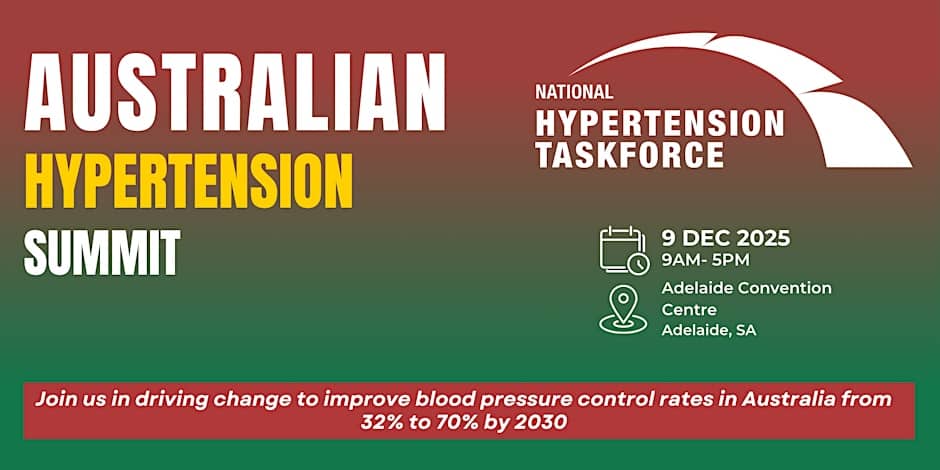
Don’t miss your last chance to secure your place at the National Hypertension Summit 2025, hosted by the National Hypertension Taskforce. This special event will run alongside the 2025 ASCEPT and Hypertension Australia Joint Scientific Meeting, at the same venue.
Professor Michael Kidd will be the keynote speaker, presenting his public health and primary health care perspective on hypertension as Australia’s Chief Medical Officer. The Summit will spotlight the latest hypertension research and innovation in Australia, while tackling one of the most pressing challenges: bridging the gap between policy and practice in team-based care. Together, the Taskforce aims to drive progress toward increasing national hypertension control rates to 70% by 2030.
The National Hypertension Taskforce and Hypertension Australia are excited to announce the publication of an important new position statement on potassium-enriched salt for patients with hypertension. This statement highlights robust global evidence showing that replacing regular salt (100% sodium chloride) with a potassium-enriched substitute (typically 75% sodium chloride and 25% potassium chloride) can significantly reduce blood pressure and cardiovascular risk.
The Taskforce recommends patients with hypertension who add salt to their food should make a 1:1 switch from regular salt to potassium-enriched salt with a composition of approximately 75% sodium chloride and 25% potassium chloride, unless they are at risk of hyperkalaemia because of kidney disease, use of a potassium supplement, use of a potassium sparing diuretic or for another reason.
This is an important milestone in advancing the Taskforce’s Roadmap to 2030, which aims to increase national blood pressure control from 32% to 70% through improved prevention, detection, and treatment.
The position statement is a result of coordinated effort by leading experts and Taskforce partner organisations across Australia. It is formally endorsed by Hypertension Australia, Kidney Health Australia, the Stroke Foundation, the Australian Cardiovascular Alliance, the Australian and New Zealand Stroke Organisation, the Australian Primary Health Care Nurses Association, the Pharmaceutical Society of Australia, and the Endocrine Society of Australia.

Associate Professor Antony Vinh heads the Hypertension and Immunobiology Research Division at La Trobe University's Centre for Cardiovascular Biology and Disease Research. With over two decades investigating hypertension's underlying mechanisms, he has secured more than $6 million in funding and published 85 scientific works. His pioneering research into inflammation, immune activation, and gut microbiome dysbiosis earned him Hypertension Australia's prestigious 2022 Jaye Chin-Dusting Outstanding Mid-Career Research Award.

The Iverson Health Innovation Research Institute, led by Director Professor Gavin Lambert, tackles cardiovascular health through transdisciplinary collaboration spanning bioengineering, computational biology, AI, and neuromodulation. Since launching in 2017, the team has published over 275 peer-reviewed articles, spawned three start-up companies, and secured competitive national grants—all focused on solving real-world health challenges through innovative, ethically-grounded research.
Hypertension Australia’s new 6-12 month Early-Mid Career Researcher (EMCR) mentoring program connects researchers with experienced mentors for guidance on research, manuscript reviews, and grant applications. Participants receive a structured handbook to optimise their mentor-mentee relationship. Hypertension Australia members are encouraged to sign up today for support in hypertension research and career development.
American Heart Association’s three-week challenge helps reduce sodium intake through simple weekly changes:
In less than one month, these small changes can lead to a big reduction in sodium intake.
Combining this approach with the Australian Hypertension Taskforce’s recent stance (read above ) on using potassium-enriched salt substitutes, pose another, perhaps more sustainable option to reduce sodium while increasing potassium intake.

The George Institute’s FoodSwitch app scans packaged food barcodes to display nutrition information using Health Star Ratings or traffic light labels. The free app suggests healthier alternatives and operates in 17 countries including Australia.

The Blood Pressure Toolkit helps individuals navigate high blood pressure management. Features include a 5-7 day average blood pressure calculator, guides for accurate blood pressure measurement at home, and educational resources about hypertension diagnosis and monitoring.

It’s not too late to register for the ASCEPT and Hypertension Australia Joint Scientific Meeting, which will be held from 9 to 12 December 2025 at the Adelaide Convention Centre in South Australia.
This landmark conference unites the Australasian Society of Clinical and Experimental Pharmacologists and Toxicologists (ASCEPT) and Hypertension Australia, bringing together leading academics, researchers, clinicians, and educators in the fields of pharmacology, toxicology, and hypertension.
Join us at the 2025 ASCEPT and Hypertension Australia Joint Scientific Meeting in Adelaide on 9 December 2025 to explore diverse career pathways in academia, industry, and teaching. Early-mid career panelists will share their experiences on career trajectories, daily responsibilities, and job realities—addressing common questions about post-thesis decisions, pursuing postdocs locally or overseas, and research career viability.

Hypertension Australia has launched a new monthly webinar series for health professionals focused on practical, evidence-based hypertension care. Each session features leading experts delivering current research and clinical guidance.
The next webinar is on 4 December 2025, The Big Switch: Building Confidence in Hypertension Care, with Prof Markus Schlaich, Prof James Sharman, Prof Mark Nelson, Dr Ania Samarawickrama and Prof Alta Schutte.
Know someone who should receive the Hypertension Australia newsletter? Simply share this with them by clicking the button below.
We’d love to hear your thoughts on what you are interested in seeing in this newsletter – please take a moment to complete the short survey below and help us improve future issues.